

How a design degree led to a ‘home-run’ career.
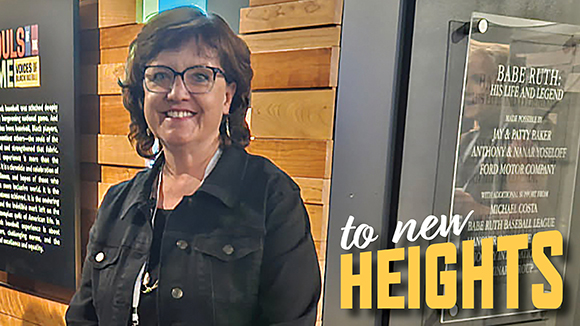
In Cooperstown, New York, the National Baseball Hall of Fame and Museum (BHOF) stands as an iconic keeper of America’s pastime. Its exhibits entertain, inform, and inspire millions of visitors each year. Behind many of those stories is Director of Exhibits and Design, Mary Wiedeman Quinn ’87. For more than two decades, Quinn has shaped the way visitors experience the game, through history, culture, and the spaces she has designed to bring baseball to life.
When Quinn first attended the Mount, however, her path wasn’t so clear.
“I knew I was creative and liked art, but turning that into a career? That seemed unlikely,” she says. “I also had interests in teaching and sociology, so I felt very undecided.”
But that uncertainty shifted during her first semester when she enrolled in an Intro to Design course, taught by Sharon Kesterson Bollen, Ed.D.
“When it came time to register for spring courses, I met with her to talk about my future—and to ask whether art was even a viable path,” Quinn says. “She didn’t hesitate. She saw something in me and made that clear. For the rest of my college career, she became my advisor and mentor. Her confidence in me was unwavering, and that made all the difference.”
Quinn went on to graduate in 1987 with a degree in Graphic Design.
“The Mount was instrumental in shaping my career,” she reflects.
Breaking into the workforce, though, proved challenging.
“At the time, employers were looking for computer-savvy candidates— unfortunately, that wasn’t me,” she says. “I picked up a few short-term jobs, but nothing truly stuck until I landed a position as a visual merchandiser in Dayton, Ohio, where I really discovered my love for visual storytelling.”
Still, retail didn’t quite feel like the right long-term fit. Quinn, then, enrolled in the Museum Studies program at The George Washington University, focusing on Exhibition Design. During graduate school, she interned at the Smithsonian Institution’s Office of Exhibits Central, where she later secured a full-time position.
“It was an incredible experience that shaped the way I think about audience, narrative, and space,” she says. “I stayed for five years, loving the work, my co-workers, and the Smithsonian!”
Eventually, she and her husband began looking to settle down in Maryland, when she spotted a job posting that would change the course of her career: Director of Exhibits and Design at the National Baseball Hall of Fame and Museum. She applied, got the job, and never looked back.
“Twenty-six years later, I’ve had the most amazing career,” she says.
Though she has always loved the game, she wouldn’t call herself “a baseball nut” she says. “I like to leave that title to the true ‘seamheads.’ For me, baseball has always been more than stats and standings. It’s a familiar, comfortable conduit for exploring deeper, more complex stories. Stories about civil rights, inclusion, gender equity, labor, economics, and American culture.”
That perspective has guided her work at the BHOF, where she sees each exhibit as an opportunity to connect audiences to something larger.
“Working in the museum field, and especially at the National Baseball Hall of Fame, has allowed me to use the game as a storytelling tool—one that connects visitors to broader historical and social themes through a subject they already care about,” she says. “That’s the real magic of baseball: it opens the door to conversations that go far beyond the field.”
One of those conversations became the highlight of her career. The project she’s most proud of is “The Souls of the Game: Voices of Black Baseball.”
The exhibit, which opened in May 2024, was built on a remarkable collaboration between the Hall of Fame team, five leading scholars, and a diverse advisory group of historians, professionals, and people active in the game today.
“The stories of Black baseball shaped not just the content, but the very form of the exhibit,” she says. “It was a project that demanded resourcefulness, creativity, and care—and it’s one I’ll carry with me for the rest of my career.”
Looking back, Quinn is deeply aware of the legacy she has created.
“The Hall of Fame’s exhibits, culture, and identity have my fingerprints all over them,” she says. “It’s incredibly meaningful to know that my work will continue to speak—quietly but powerfully—for years to come.”
To today’s students, she offers the wisdom of someone who once stood at the same uncertain starting line.
“It’s OK not to have it all figured out,” she says. “When I started college, and even after, I had no idea what I wanted to do. Stay open—you’ll find your path.”
She encourages them to listen to those who believe in them, just as she once did.
“One professor’s confidence in me changed everything,” she says.
“Sometimes others see your potential before you do.”
And most of all, she emphasizes collaboration.
“The best projects happen through collaboration, listening, and learning from others.”