

Coincidence, generosity, and hard work resulted in the Mount once again having an operational pipe organ in Mater Dei Chapel.
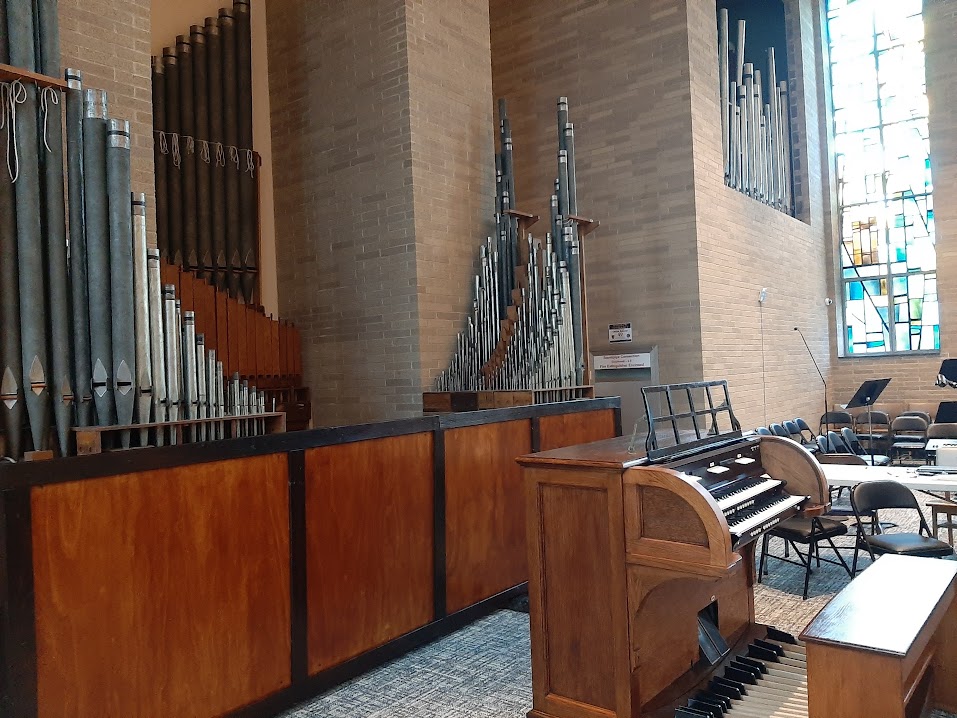
Thanks to the Sisters of Notre Dame of the United States, the Mount again has a functional organ.
Dr. Jim Bodle is a member of the chapel restoration committee. He explains that two organ builders examined the old instrument in Mater Dei Chapel and determined it was beyond repair; the expense to fix it would have been as much as entirely replacing it.
Dean Mike Sontag describes what the Mount had planned to do about the unusable MSJ organ: the tentative plan was to install a digital organ in Mater Dei Chapel in place of the original one. However, this was not a satisfactory solution. A digital organ simply doesn’t move air the same way. Compared to a real pipe organ, the sound is disappointing. A digital organ also has a shorter lifespan, lasting only 20 to 30 years. If a problem arises, the entire unit would likely have to be replaced. A pipe organ, on the other hand, has the potential to last for as long as it can be maintained. Still, the reluctant plan was to install a digital organ.
A chance encounter Sontag had changed that. One day last summer, he visited Delhi Barbers for a haircut. Sontag, a regular, enjoys talking to the owner, Victor Fabro. Fabro is active in Holy Family parish in Price Hill, serving, for example, on their parish council. Fabro mentioned to Sontag that the Sisters of Notre Dame of the United States (located in Covington, Ky.) were offering the worship materials from their chapel. Fabro himself had gone that day to see what materials his parish could use. As he listed what the Sisters of Notre Dame were still offering, he mentioned the pipe organ. When Sontag got back to campus, he shared the news with the right people, beginning a yearlong process culminating in the installation of the instrument at the Mount.
But why were the Sisters of Notre Dame getting rid of such an instrument? Joe Shadle, MSJ’s Chief Mission Officer, has been the contact between Mount St. Joseph, the Sisters of Notre Dame of the United States, and the organ builder. He coordinated with each party to make the installation possible.
Shadle explains that the Sisters of Notre Dame were tearing down the St. Joseph Heights Provincial House (the equivalent of the Sisters of Charity’s Motherhouse) and generously were offering to share worship materials from its chapel before it was demolished. The Sisters of Notre Dame donated their 99-year-old pipe organ to the Mount, and private donations funded the installation of it in Mater Dei Chapel.
The Sisters of Notre Dame’s pipe organ was in good shape. Since its original installation in the St. Joseph Heights Provincial House in 1927, the same company has always maintained the organ. George Kilgen was once the largest organ builder in the country, based in St. Louis. The company had a branch office in Cincinnati which outlived the larger corporation. This office installed the pipe organ originally for the Sisters of Notre Dame. In the 1980s, the local Kilgen branch was bought out and became Schaedle Pipe Organ Service, the builder who reassembled the organ at Mater Dei Chapel. Despite changes in ownership, the same company has maintained the pipe organ since its original installation in 1927.
The organ’s installation at the Mount was no small task. The pipe organ is a huge instrument and had to be entirely dismantled to be transported to campus. When it was being taken apart, the organ builders didn’t even have electricity, because the chapel was about to be torn down. They had to disassemble and remove the instrument using only flashlights and headlamps. The first pieces arrived at Mater Dei Chapel in September 2025, where it then had to be rebuilt.
Other MSJ faculty also played a key role in preparing the chapel for the instrument. The MSJ Campus Facilities and Operations team updated the power supply in the choir loft and replaced the old flooring with carpet, which is better for the instrument. These renovations were essential for the operation of the pipe organ. MSJ staff—specifically Dave Rohe and Bill Fellinger—completed key work that made the installation of the organ successful.
After its almost 100 years of use—and historic move from Covington to Delhi—the pipe organ has been rebuilt. Except for future tweaks to the instrument as it settles, it is tuned and ready to play again.
The entire process has been a collaboration between the Delhi community, MSJ faculty and staff, and the Sisters of Notre Dame of the United States. And this has been mutually beneficial for both religious communities too. The pipe organ has found a new life and a new home at the Mount, where it will be cared for and prayed with regularly. It will continue to be played and cherished for many years to come.
The Mount has also benefited, because the pipe organ is more than just an instrument. Sontag describes how the pipe organ’s sound is unmatched—especially compared to a digital organ. The Mater Dei Chapel was intentionally designed, under Sister Augusta Zimmer’s guidance, to host a pipe organ, Shadle said; the instrument echoes and resonates powerfully in the space. A real pipe organ adds to the liturgy and enhances the mass.
Bodle expounded on this, noting that the pipe organ is an important part of the traditional mass. And for people who have rented Mater Dei Chapel for weddings in the past, the absence of a functional pipe organ was often a disappointment. That is no longer a problem.
The instrument bolsters MSJ’s music programs as well; many MSJ music majors go on to work in churches. Now those students can learn and practice on a pipe organ. Having a pipe organ provides valuable experience for MSJ musicians and will draw students and performers to campus.
The organ is also a statement, Sontag says, an anchor of sorts. It is a reflection of the Mount’s commitment to stewardship—to maintaining this device for decades to come. The Mount will continue to care for this instrument and what it represents—for its next hundred years of use.
With the organ now under the care of Mount St. Joseph University, a new chapter in the history of Mater Dei Chapel is being written. However, in a special way, the legacy of the original pipe organ installed in Mater Dei Chapel in the early 1960s continues. Bodle described how a few pipes from the original MSJ organ were used to replace damaged pipes in the Sisters of Notre Dame’s organ. The blower motor and two wind reservoirs original to the Mater Dei organ also were incorporated into the rebuilt organ. There is a harmony of the two instruments and two histories in the revitalized pipe organ—an instrument that is now ready to fill a beautiful space with its exceptional sound.
The collaboration between MSJ faculty and staff, the Sisters of Notre Dame of the United States, and the Delhi community has breathed new life into the historic Mater Dei Chapel, where the pipe organ will again enrich the worship experience.
On Sunday, Oct. 25 at 10 a.m.. the Archbishop of Cincinnati, Robert G. Casey, will preside over mass in Mater Dei Chapel and bless the pipe organ.