

Director of the Wellness Center, Jaimi Cabrera, details how the Wellness Center combines the eight dimensions of wellness to facilitate wellness for both students and employees within the Mount Community.
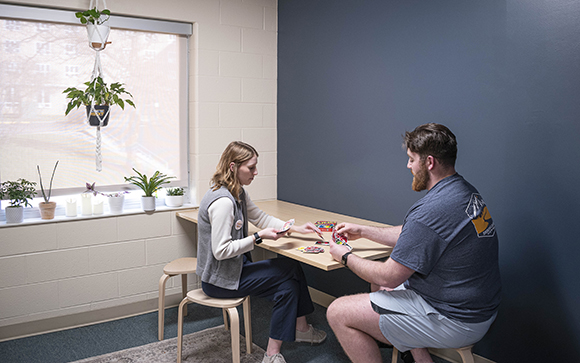
A licensed independent Social Worker, Jaimi was looking for a place to use her skills as a means to help others. She had spent most of her professional career working in the areas of mental health treatment and prevention. Having been a collegiate swimmer and having worked as a college swim coach for five years, she knew she wanted to serve a campus. With its long tradition of service through the Sisters of Charity, the Mount stood out to her as the natural place to serve. “Everything that the Mount had to offer aligned with my mission and purpose for doing the work that I want to do,” Jaimi states. Now, serving as the director of the Wellness Center, Jaimi outlines how the dedicated team at the Wellness Center have supported and plan to continue supporting wellness on campus through the eight dimensions of wellness.
The eight dimensions of wellness encompass a range of wellness needs, and address the following: Emotional, physical, social, spiritual, environmental, occupational, intellectual, financial, and spiritual.
- A focus on emotional needs is a more traditional approach to providing services, where cognitive, emotional needs are the core focus.
- The physical element focuses on physical health through factors such as nutrition and fitness.
- Social wellness focuses on how one interacts with others and feels seen in their environment.
- Spiritual encompasses one’s ability to find a greater meaning in life. Though the name could imply a religious component and spiritual wellness can certainly be tied to religion, finding and feeling a sense of greater meaning in life can be a secular search as well.
- Environmental wellness places an emphasis on feeling safe and accepted in a given environment.
- Occupational focuses on a feeling of validation in one being satisfied with their profession or educational path.
- Intellectual places an emphasis on feeling fulfilled through intellectual stimulation and a feeling of intellectual growth.
- Financial addresses the wellness that comes with feeling more financially secure, allowing for more freedom in spending and less stress in life.
“As we look at holistic health and supporting the eight dimensions of wellness, it really is for everyone on campus,” Jaimi declares. She notes that these dimensions help students regulate their emotions, handle stress, and overcome challenges. “I think those aspects of wellness are really so important to students and their academic success. The dimensions provide soft skills that we all need to be successful. The degree is important, but you still need to be able to regulate your emotions, handle stress, celebrate successes and overcome challenges.”
The holistic approach of the Wellness Center is not just for students, but for employees as well. The Wellness Center has been working with the HR (Human Resources) team at the Mount to support employee wellness. “If we are not well ourselves, how are we supposed to support our students?” Jaimi poses. “I think that it will help students succeed, as well as all of us in our roles here at the Mount succeed. I’m interested in continuing to build out more opportunities and resources to support our employees and their wellness.” By facilitating the success of Mount employees, the Wellness Center provides a means to succeed for the entire Mount Community.
The Wellness Center’s focus on the eight dimensions of wellness separates it from traditional approaches to mental health services, which primarily focus on emotional needs alone, and focus primarily on providing services after a need for them is found. The Wellness Center is unique in the fact that it places a great focus on prevention, alongside services. “What I’ve been really proud of is building out that eight dimensions of wellness preventative model,” Jaimi says. “It’s a universal care model, where everyone can benefit from just a short interaction.”
Multiple preventative strategies aligned with the eight dimensions of wellness to promote wellness on campus are utilized by the Wellness Center. Preventative strategies include tabling events such as “Wello-Ween” in October, employee training, dedicating each month of the year to a different dimension of wellness, and regular wellness events such as the bringing of Willow the Therapy Dog to campus. The Wellness Center has also partnered with TriHealth to have a dedicated nurse practitioner on campus, allowing students and employees easy access to healthcare. “She can provide physical healthcare to our students and our employees as well,” Jaimi states.
Additional Services Offered
The Wellness Center provides a range of different services to accommodate campus. A Let’s Talk Appointment is a 30-minute appointment to help students decide what services they need, or to come in for short-term concerns. “If you have a more short-term concern like an upcoming sports match, an upcoming exam, a peer conflict, a Let’s Talk Appointment would be good for getting your needs met and coming back if you need us,” she says.
Further, The Wellness Center has also partnered with UWill, which students can register for with their MSJ email address, to receive free virtual counseling services and access to an after-hour needs emergency number. “You can pick your provider,” Jaimi says. “UWill offers greater diversity in providers.” UWill also provides access to a free wellness library, which provides plenty of great wellness and mindfulness practices.
Additionally, services beyond traditional counseling are offered to students. Students can schedule an appointment for “Grow Coaching,” in which they are walked through the eight dimensions of wellness to assess how they’re doing in each dimension. Students can also spend time in the Zen Den, a dedicated room in the Wellness Center with a couch, fidgets, etc., as well as Zen Den To-go Kits including equipped with hands-on tools and activities to help engage and calm the mind, including color pencils, origami, therapy cards, and more. Perhaps the most successful wellness program has been Lions Cupboard, which addresses the physical and financial needs of wellness by providing free non-perishable food items and hygiene products to students struggling with financial/food insecurities.
“We’re tracking benchmarks, and we can see that more students than ever are using the Lions Cupboard,” Jaimi notes. She attributes the expansion of Lions Cupboard’s use to its relocation to the bottom of Seton, making it more accessible.
Overall, the Wellness Center team believes they have collectively had a significant impact on the ability of students to be attentive and successful in their classes, and work towards their final destination: Graduation.
“More students are coming to the Wellness Center than ever, and we’re touching a significant number of students through our universal, monthly events,” says Jaimi. “I do believe that we’ve made a significant impact and continue to do so.”
If Interested in Receiving Services From the Wellness Center
Contact can be made with the Wellness Center by emailing Wellness.Center@msj.edu or calling 513-244-4949. If interested in learning more about the services the Wellness Center has to offer, click this link to visit the Wellness Center’s page on the MSJ website.