

By: Tori Orbegozo
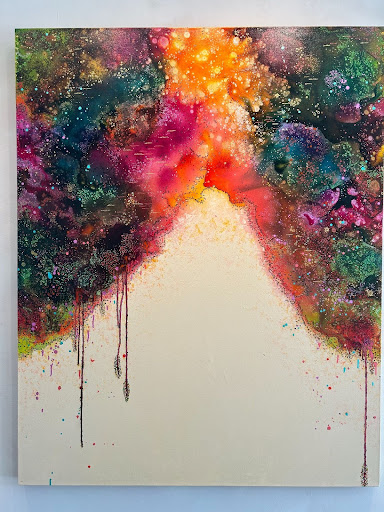
In this painting, Dewy Dawn on Poet’s Street, created by Priya Rama, I see explosions of saturated warm and cool colors forming organic shapes, thin horizontal lines, and circular shapes covering the top half of the canvas. The smaller circular shapes overlapping the bright colors create a bumpy texture against the canvas. On the left, the mixture of colors ascends up the middle of the canvas, where they peak in the center, then descend back toward the right side. In the bottom corner of the canvas, paint drips create a grouping of lines that flow down, pointing to the bottom edge. Two of the lines are surrounded at the tips by smaller circular dots. This shape is also repeated on the right corner of the canvas, where the line runs completely off the edge. Lastly, there is a large central spatter of orange hues surrounded by slightly desaturated blue-green and violet organic shapes.
The slope of colors creates a nearly symmetrical visual balance of the elements in the artwork. Although the subject of the piece is top-heavy, the stark contrast of colors against the plain cream background anchors the painting. The colors in this piece spread and interact with one another, creating a swirling, active movement that can be felt throughout the piece and sensed within the viewer’s body. The repetition of circular shapes and dots creates a sense of depth within the piece. There is an emphasis on the orange shape, as it is central in the painting, and the peak of the cream background leads the viewer’s eye up to it.
Despite the viewer’s personal interpretation of this abstract piece (artist’s response below), it is clear that it was created as a form of internal expression by the artist. This artwork appears to be a vessel of feelings, movements, and textures that come together to form something that can be interpreted in multiple ways. When looking at this piece, much of its content can be related to the natural world. The interactions of saturated and desaturated colors cause waves and wisps of individual colors to seep through, similar to what can be seen in supernovas in space. Explosions of giant dying stars cause an intermixing of bright beams of light, which we interpret as different hues. The texture created by the circular tints of color and added shapes also relates to the textures that can be seen inside geodes. The interaction of light with the crystal formations found inside geodes creates a prickly, bumpy texture, which can also be seen within this piece. Lastly, the flowing organic shapes created by the hues in this piece mimic the natural shapes of coral reefs. The repeated flattened ellipse shapes overlap the fields of color like schools of tiny fish swimming together through a reef.
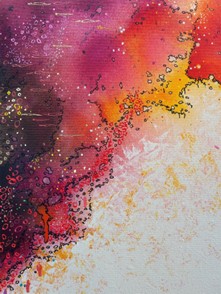
The overall balance and contrast created between explosions of color and texture, juxtaposed with a flat cream-colored canvas, serve the artist well in creating a successful and balanced piece. The abstracted and aesthetic value of this artwork allows viewers to latch onto the pieces they relate to and form their own connections with the piece based on their own experiences. Although the color palette was not as refined or simplistic, the added texture and movement create a sense of dimension that makes for a visually intriguing piece. The longer someone spends looking into the depths of the painting, the more they will discover. When a piece can balance aesthetics with deeper meaning and connect with its audience, it’s successful and achieves every bit of its purpose: serving to convey messages, express emotions, explore the human experience, and enhance cultural understanding.
…
After speaking with the artist, she stated, “You have, in my opinion, truly ‘understood’ this painting.” Rama explained to me that, even though her works are born from a very personal experience, many aspects of her life and art background inform her painting process. She experiences chronic migraines, which allow her to see colors and shapes when she closes her eyes. She describes, “These mystical images recede, shift, radiate, and pulse, becoming more vibrant and vivid as time goes on. Frequently, I paint through a migraine, trying to quickly tap into what I see.” She uses this process as a form of meditation, becoming one with her art as she acknowledges the pain and chaos. It is difficult for us to separate the biological and lived aspects of our lives, which is evident in her paintings. Finally, Rama declared, “Often, completing a painting acts as a relief, and reminds me that my mind can do more than just process pain: it can transform pain into beauty.”
I am glad I wrote my interpretation before our deeper conversation, where I learned about the birthplace of her work. The new information did not change my viewpoint, but reinforced and supported my overall understanding of the piece. The intricate layers of meaning and imagery within Rama’s work showed me the beauty of analyzing art and have inspired my own creative journey. As a Fine Arts major, when creating, I wonder if viewers understand my work and the message I had originally intended, or if something new and unique to that individual will be born.
My experience and learning at a Liberal Arts university supports and broadens my knowledge about others’ as well as my own work. It has served as a way to impart an expansive general knowledge and help me develop intellectual capacities that allow me to interpret and comprehend artwork from cultures and lived experiences different from my own. This is the reason why I enjoy going to exhibitions such as Cultural Traditions & Artistic Voices at Studio San Giuseppe Art Gallery. The wide variety of work displayed not only enlarges my understanding of art but also helps me learn more about my own artistic and creative voice in the process. Students also get the opportunity to discuss artwork with professionals, and learn more about their process, their inspiration, and how they are able to make a meaningful career out of doing what they love. The vast range of artwork that I am exposed to in my educational environment aids me in creating a conscientious viewpoint of the capacities of art, and proves to be just a small part of the extensive value of a Liberal Arts education.