

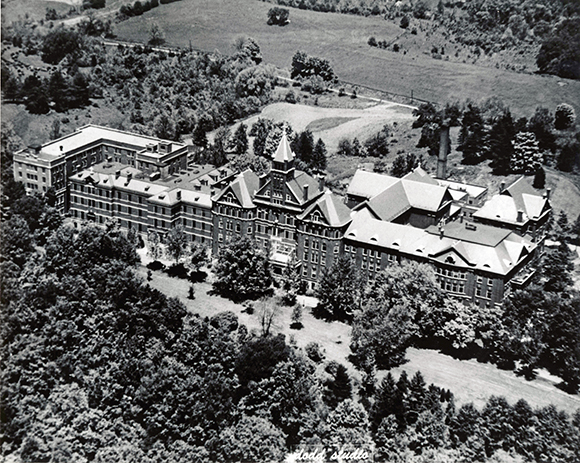
The Mount St. Joseph Motherhouse sits tall and proud on Bender Road as the home to the Sisters of Charity of Cincinnati.
They came to Cincinnati with the simple mission of helping the poor, and when Mother Margaret George, a friend of founder Elizabeth Bayley Seton, moved her community from Emmitsburg, Md., she created a legacy that has lasted to this day.
The Sisters of Charity came from Emmitsburg, Md., to Cincinnati in 1829. They set up shop in a small A-frame house in the heart of the city, named St. Peter’s, where they assisted the archbishop in his request to care for the girls in the newly established orphanage. In the following years, there was a cholera epidemic, and as the number of orphans grew, the sisters welcomed them with open arms. With the support of the archbishop and generous donors, the sisters' mission grew, as did their properties. Settling into the atmosphere of Cincinnati, seven Sisters who decided to remain instead of going back to Emmitsburg were officially named the first Sisters of Charity of Cincinnati in 1852.
In 1853, they purchased a home they named Mount Saint Vincent on Lehman Road to function as their first motherhouse and schoolhouse. By 1857, they had outgrown this space, so another estate further into Price Hill. called The Cedars in Cedar Grove, was established. You may know the space now as Seton High School, named for the woman who founded the Sisters of Charity in Emmitsburg, Elizabeth Ann Seton. Their goal with these properties, known as “the cradle,” was to move out of the bustling environment of the city and into the quieter suburbs where they could continue their mission to teach the community.
Later in the 1800s, the sisters’ mission expanded beyond schooling children. The 1860s brought the Civil War, and many sisters took up the mantle of nurses for injured soldiers using St. John’s Hospital, another building the sisters ran. As they became more involved in the community's needs, they purchased the Biggs farm in 1869, which sits across the street from Mount St. Joseph University.
Price Hill was rapidly becoming more populated, losing the rural atmosphere the sisters needed, so they purchased a small farmhouse across the street from what is now MSJU, but in the early 1880s, they moved into a property across the street as their new motherhouse. Unfortunately, as construction went on for an expanded east wing, the building caught fire in July of 1885. Built primarily of limestone, the building kept heat in, and fire trucks were not able to securely find a water supply to quench the flames. Not to be deterred, reconstruction began just days later, and by 1886, Marian Hall was completed. Marian Hall is the oldest standing part of the motherhouse, and additions were steadily built to keep up with the sisters' rising numbers.
If you look at the Motherhouse now, you can see the history carved into its stone and brick. The campus is completely self-sustaining; you can see solar panels on top of roofs, and rainwater is recycled throughout the building. Where Bayley, a senior care facility, now stands was a farm run by the sisters and volunteers, but it has now moved just across the street. In their time in Delhi, the sisters have advocated for the train station on River Road, created bus routes throughout Delhi, built and run schoolhouses, including MSJU and Seton High School, and helped the community in more ways than we can count.
All of this is the direct result of the sisters’ response of kindness to a struggling city. So next time you drive down Bender Road, give a wave of thanks to the Sisters of Charity of Cincinnati for all their hard work and dedication to our community.
Special thanks to Veronica Buchanan, Archivist for the Sisters of Charity of Cincinnati, for help with this story.