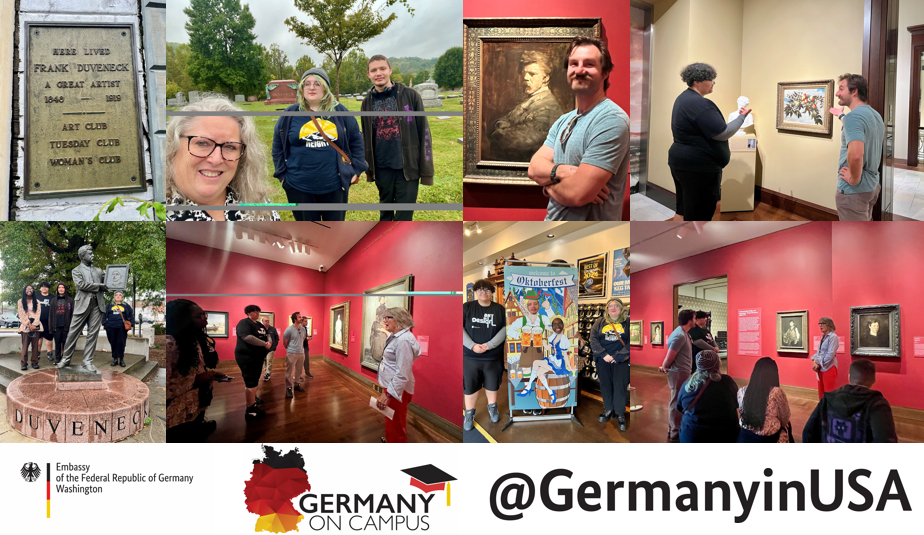
MSJ Art & Design students explore Frank Duveneck’s artistic legacy through local landmarks, original artwork and connections to the Sisters of Charity.
Mount St. Joseph University Art & Design students recently stepped outside the classroom to explore the life, work and Cincinnati connections of renowned American artist Frank Duveneck, experiencing firsthand how artists, institutions and communities shape the cultural history of a city.
Supported through the Germany on Campus grant from the German Embassy, the field experience connected students with Duveneck’s German heritage and artistic education while encouraging them to learn through the places where Cincinnati’s art history unfolded. Rather than studying Duveneck solely through textbooks or reproductions, students visited significant locations connected to his life, viewed examples of his work in local churches and explored his legacy at the Cincinnati Art Museum.
Learning Through Place
The experience emphasized the importance of learning by visiting the places where history happened. Students traveled to Covington, Kentucky, to explore the community where Duveneck was born and raised and to see firsthand the places connected to his life.
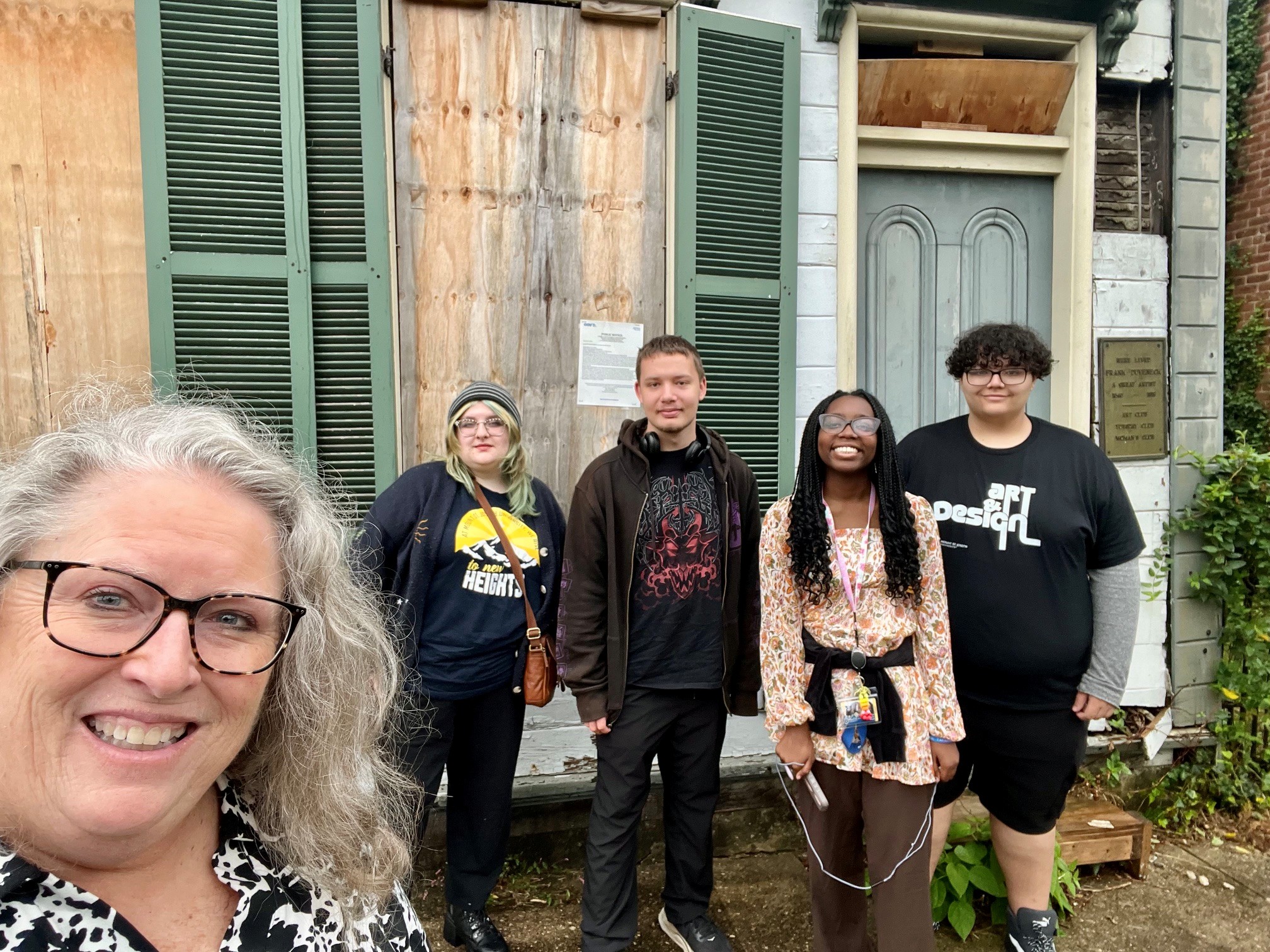
Students visited Duveneck’s childhood home and studio on Greenup Street, gaining a sense of the neighborhood and environment in which the artist spent his early years. They also visited Mother of God Church, where he grew up in the church.
“The church Frank went to was so beautiful,” said MSJ Art & Design student Patience. “Seeing his house and studio was pretty cool. I was very surprised about how big his grave [was]. His wife was also talented in painting. I wish we could have seen more of her art.”
The group then visited the Cathedral Basilica of the Assumption in Covington, another significant site for understanding the artistic heritage of the region which includes a triptych of Duveneck’s. Seeing artwork within its original architectural and religious settings allowed students to consider how artists created work for specific communities and spaces rather than simply viewing the pieces as objects in a museum.
Students also visited Mother of God Cemetery, where Duveneck is buried. Standing at his gravesite provided another opportunity to connect the artist's biography with the places that shaped his life and his lasting connection to the Cincinnati region.
These visits transformed the study of Duveneck from a traditional art history lesson into an immersive experience.
From Cincinnati to Munich and Back
Duveneck's life also gave students an opportunity to explore the movement of artistic ideas between Cincinnati and Europe. Born in Covington in 1848 to German immigrant parents, Duveneck traveled to Munich, Germany, where he studied art and developed his skills before returning to the United States.
Students learned how Duveneck's artistic style developed over the course of his career, including changes in the way he approached portraiture. His work provided an opportunity to discuss the contrast between tightly rendered details and more expressive, painterly approaches.
“I loved seeing the variation in his style,” said MSJ Art & Design student Alice. “He had both a super tight, neat, realistic style as well as a very loose, painterly style. I especially liked the painterly style because you could see the focus on the face and then the detail defuses the further away from the face you get. You can tell that he was painting a person he met and not just someone he made up or didn’t know about.”
Another student, Caleb, was particularly interested in Duveneck's approach to portraiture.
“I learned that Frank Duveneck was an artist based in Cincinnati, but he went to Germany to learn art,” Caleb said. “He has had a movement in his art style that went from dark portraits to lighter ones. It’s very interesting how his portraits are not as detailed as others, like backgrounds, body figures, hands, etc. However, the portraits had very detailed faces.”
Caleb also noticed a striking difference in Duveneck's paintings of his wife and her father, observing that those works felt particularly detailed and captured their expressions beautifully.
The experience continued at the Cincinnati Art Museum, where students encountered Duveneck's work firsthand. Seeing original artwork allowed students to closely examine qualities that can be difficult to understand through digital images, including brushwork, scale, surface, color and the physical presence of the artwork.
For students studying art and design, the museum experience also provided an opportunity to look closely at Duveneck's technical decisions. Rather than simply identifying what a painting depicted, students considered how Duveneck painted where he used detail, where he allowed brushwork to remain visible and how he directed attention toward the faces of his subjects. The docent added insight into the visit with her knowledge and understanding in the greater context of Cincinnati artistic traditions.
Alice's observation about Duveneck's painterly approach illustrates the kind of close looking the field experience encouraged. Students could see how areas of a painting become increasingly loose and expressive as they move away from the primary focal point.
The museum visit also allowed students to consider Duveneck's relationships with the people he painted. His portraits provided evidence of an artist responding to individual subjects rather than simply creating generalized figures.
A Direct Connection to the Sisters of Charity
Perhaps one of the most meaningful discoveries for the MSJ students was the connection between Duveneck and the Sisters of Charity of Cincinnati.
When Duveneck returned to the United States and taught at the Art Academy of Cincinnati, four Sisters of Charity studied directly under his tutelage: Sister Ernestine Foskey; Sister Olivia Lefevre; Sister Appolonia Liguori; and Sister Ann Xavier Magvney. These pioneering artist and nuns brought their appreciation and knowledge of fine art back to the convent, creating an important cultural connection between Cincinnati's art community and the Sisters of Charity.
Duveneck's influence also extended into his own family. His wife, Elizabeth Boott Duveneck, was an accomplished artist and had studied with him. For students, learning about Elizabeth provided another opportunity to consider the role of women artists during the period and the artistic relationships within Duveneck's own life. Patience's response reflects that curiosity: “His wife was also talented in painting. I wish we could have seen more of her art.”
The artistic education of the Sisters of Charity helped establish a foundation for the Sisters' continued engagement with the arts. Decades later, Sister Augusta Zimmer would advocate for and pursue formal art education at the School of the Art Institute of Chicago, further extending the Sisters of Charity's involvement in art and art education. For today's MSJ Art & Design students, the story offers a direct connection between the history they were studying and the institution they attend today.
The field experience encouraged students to see Cincinnati and Northern Kentucky as an extension of their classroom. By visiting Duveneck's childhood home and studio, viewing his artwork at Mother of God Church and the Cathedral Basilica of the Assumption, standing at his gravesite at Mother of God Cemetery and studying his work at the Cincinnati Art Museum, students were able to connect art history with the physical places where that history occurred. By walking through the communities connected to Duveneck and studying original works in both historic and museum settings, MSJ students experienced art history as something lived, local and connected to place.
The experience was made possible through the Germany on Campus grant from the German Embassy, providing MSJ students with an opportunity to explore the German cultural connections embedded in Cincinnati's artistic history while discovering an unexpected and deeply meaningful connection to the Sisters of Charity and Mount St. Joseph University.