
When doctors told Matthew Webb he would never walk again, he refused to believe it.
In July 2022, while vacationing in the Bahamas, Webb fell 25 feet, shattering his L1 vertebrae and paralyzing him from the waist down. For months, he worked with therapists, determined to regain movement.
Two weeks after he took his first assisted step, the rehabilitation center delivered devastating news: he had exhausted his insurance coverage.
“They told me I was out of visits—unless I wanted to pay $20,000 a month,” Webb says. “It was crushing. To be working so incredibly hard and get that glimpse of success, and then to hear that news was devastating—especially at such a pivotal time for healing and recovery.”
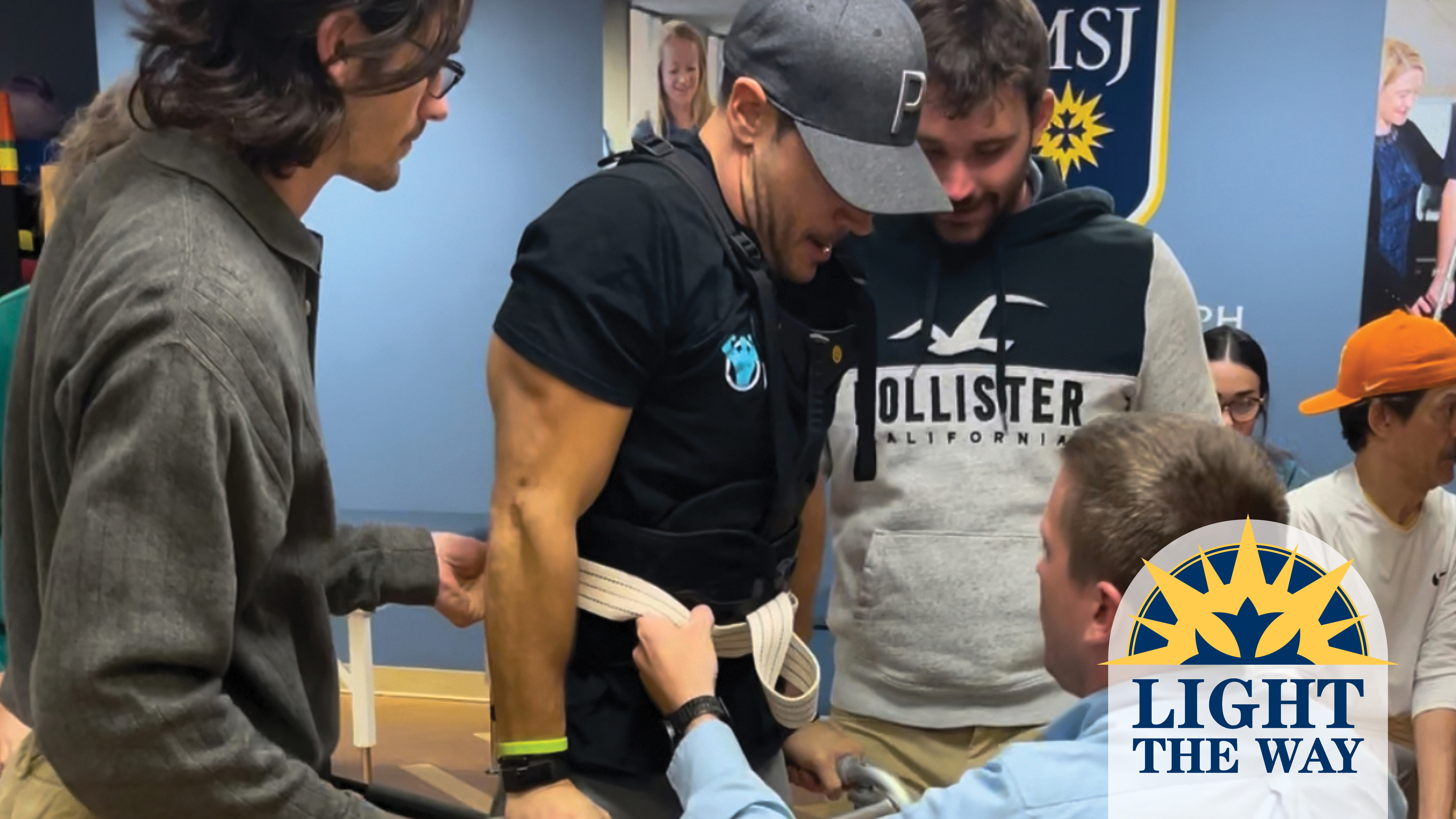
One of his therapists suggested he try Mount St. Joseph University’s pro bono physical therapy clinic. Webb immediately reached out.
“There’s no way I would be where I am now without the clinic,” says Webb, who lives in Northern Kentucky with his wife and two young children. “They literally helped me get back on my feet.”
After hundreds of hours of therapy, about six months ago, he took his first unassisted steps—wobbly ones, but still steps.
“It was sheer joy,” he says. “Sheer excitement … I am working hard every day to recover so I can go back to work and provide for my family.”
Today, Webb walks with arm crutches. He hasn’t sat in a wheelchair in nearly a year. Before the accident, Webb spent the summers wake-surfing at Norris Lake with his family. He was active in CrossFit and enjoyed a round of golf. He wants to return to that active lifestyle, and he’s made great progress. He can navigate his way across uneven ground on the soccer fields to cheer on his children, 11-year-old Violet and 8-year-old Wyatt.
Now on long-term disability, Webb completes some type of physical therapy every day. But his insurance still maxes out at 20 visits a year. His time at the pro bono clinic continues to play a crucial role in his recovery and moving toward fulfilling his ultimate goal: walking his daughter down the aisle one day when she gets married.
“Everything the Mount clinic has done has allowed me to take these steps,” Webb says.
Webb’s recovery inspired his niece, Makenzie Guenther, to pursue a career as a physical therapist. Today, she is a first-year student in the Mount’s Doctor of Physical Therapy (DPT) program.
“It feels amazing to know I’m part of something that helped change his life,” Guenther says. “I have seen firsthand how much the professors and the students care about the clinic and about helping serve their community. I knew that was the type of place where I wanted to learn.”
Doctor of Physical Therapy Lights the Way
The Mount’s Physical Therapy program offers numerous opportunities for DPT faculty, alumni, and students to Light the Way in their communities. A master’s program for Physical Therapy began in 1999, under the umbrella of the University’s School of Health Sciences, which also includes nursing, physician assistant studies, speech-language pathology, social work, and exercise science.
In 2006, the exercise and integrative health science master’s program transitioned into a Doctor of Physical Therapy. Based on a three-year (nine-semester) calendar, the program combines rigorous academics with extensive clinical experience.
Since the inaugural class in 1999, the Mount’s Physical Therapy program has graduated 786 students, all with a mission for “Engaging students in a personalized and collaborative learning environment that empowers them to become physical therapists who have a commitment to lifelong learning, a passion for serving others, and a dedication to interprofessional practice that inspire them to optimize the health and well-being of the community.”
Dr. Karen Holtgrefe, a former faculty member of the Mount’s Physical Therapy program, along with Dr. Lisa Dehner, the program’s current department chair, believed that a pro bono clinic embodied that mission. They worked for years to get all the necessary pieces in place to establish a student-run pro bono clinic. Holtgrefe collaborated with Maegan McCarthy, then-director of the student pro bono clinic board and a 2024 DPT graduate, as well as nearly 25 other second-year students, to develop processes and policies that enabled them to begin serving the community in the fall of 2022.
The clinic traditionally runs for 10 weeks in the fall and 10 weeks in the spring, on Tuesday evenings and Saturday mornings. Students are supervised by volunteer, licensed physical therapists—often alumni—and run the clinic under the guidance of faculty liaison Dr. Jamie Bayliss, director of clinical education and associate professor. In addition to providing therapy, the students’ work includes patient scheduling, DPT student, and volunteer clinician scheduling, marketing, fundraising, clinic operations, and data collection.
To date, students have already provided more than 673 visits for patients, ages 10 to 89, with a variety of diagnoses, ranging from orthopedic to neurologic conditions, delivering a total of $82,997 in free care.
For Webb, every step he takes is proof of that mission in action.
“The impact of this program in the community is tremendous,” he says. “It’s been such a blessing.”
“The clinic provides MSJ students with an opportunity to serve the community and individuals like Webb who might otherwise not receive the therapy they need,” Bayliss says.
“It also serves our students by allowing them to utilize the skills they’re learning in the classroom and to perfect those skills,” she says. “Another wonderful thing we’ve experienced is the relationship that develops between these patients and students. The patients know our students are learning, so they’re very understanding. Our students come out of the experience with more confidence, so when they begin their clinicals, they hit the ground running.
Third-year student William “Willie” Wolfe says the clinic confirmed his sense of vocation.
“The pro bono clinic gave me my first real patient interactions,” he says. “Seeing patients progress and regain movement reinforced why I’m doing this. I feel like my place in this world is to be a bridge to a better life for others.”
In addition to the pro bono clinic, students donate hundreds of hours of volunteer service each year, from conducting fall risk screenings at senior centers to supporting adaptive sports programs for athletes with disabilities. Some students even volunteer at one of the local fire stations, helping firefighters do strength training to prevent injuries.
“I think the Mount really emphasizes the importance of going above and beyond to get to know your patients and really, truly care about them, rather than just getting them in and out of the door,” says Tanner Perry, a third-year student who serves as the vice president of the MSJ Student Physical Therapy Association. “That’s something I’m going to take with me as I begin my career: that our job is to show true care and compassion.”
Bayliss agrees.
“We’re Lighting the Way by educating students who not only have the knowledge to treat people, but also the compassion to serve.”
Leading by Example
At the heart of the program are faculty members who are passionate practitioners and teachers. They have an open-door policy and meet frequently with students, one-onone or in small groups. And they model deep engagement with colleagues, students, patients, and the profession.
“We are all American Physical Therapy Association members,” Dehner says. “We are advocates for our profession and for our students. And we are all clinicians. Every single one of us still sees patients.”
Faculty practice what Dehner calls a “formal informal” approach.
“The analogy I like to use is that we’re all in the boat,” she says. “I’ve got an oar, you’ve got an oar, and we’re in this together. I think that creates a lot of modeling where the students see that we are professionals with experience and knowledge to share—and we are also colleagues working together for the same goal.”
The program is intentionally student-centered, with a focus on competence and compassion.
“Our grads are known for their professionalism and compassion,” Bayliss says. “If you can’t communicate, if you can’t actively listen, you can’t treat patients effectively. We model that every day.”
Dean of Health Sciences, Dr. Darla Vale, echoes that sentiment.
“Our faculty members are very passionate about their profession and committed to teaching students not only how to be competent practitioners, which is very important, but also to understand that compassion is a critical part of the job. I always think about the words of Maya Angelou that people may forget what you say, but they’ll never forget how you made them feel.”
Faculty members extend that passion outside the classroom, too—hosting fundraisers for student scholarships, creating a “draft day” celebration when students receive their first clinical education experiences assignments, and serving side-by-side with students in the pro bono clinic.
“I think what makes the Mount stand out is that we really cater to the student individually,” says Monica Myers, a physical therapy instructor. “My students know me. They’re constantly coming up to me, in my office or after class, asking questions. Being at a smaller school is hugely beneficial because we can spend a lot of time with our students and get to know them.”
The curriculum is designed to forge those deep connections. Faculty begin with first-year students and then follow the students into their second and third years.
“I get to see them from when they first walk in and they’re scared to death, to their progression in the second year, to the third year, when they’re studying for their boards and able to answer questions for the new cohort of students,” Myers says. “I think our individualized program gives a lot of people who may not have done well in a big academic institution an opportunity to thrive and succeed.”
Called to Serve
Both faculty and students liken physical therapy to a calling—a vocation deeply rooted in the desire to serve and help others. For many, a personal experience with physical therapy solidified their interests.
Bayliss injured her ankle at the age of 10 while competing in gymnastics.
“My therapist was so passionate and knowledgeable,” she says. “She made such an impression on me, and I wanted to be able to help people like she did.”
Years later, Bayliss would discover that very therapist—Mary Romanello—had become chair of the Mount’s Physical Therapy program.
“I guess it was fate or divine intervention,” Bayliss says, “for the program chair of my program to be the reason I got into the profession in the first place.”
Perry was inspired by his father’s accident in 2011.
“My dad became a bilateral below-the-knee amputee,” he says. “Watching his therapists help him walk again showed me the power of physical therapy. They didn’t just restore his physical ability; they helped him see that life may not be what it was, but there’s nothing wrong with making ‘different’ your new normal.”
Myers’ interest in physical therapy sparked in high school when a family friend suffered a non-traumatic spinal cord injury.
“She’s still paralyzed to this day and uses a manual wheelchair, but she is completely independent,” she says. “It was truly inspiring to see the role physical therapists played in helping her get back to doing everything she wanted—going to college, living on her own. That experience really piqued my interest.”
Before she came to the Mount, Myers worked at a Cincinnati rehab center, where she encountered Webb. When she learned that his insurance wouldn’t cover additional treatment, she referred him to the Mount’s pro bono clinic. She has seen him progress from celebrating the wiggle of a toe to walking and driving.
“It’s wonderful to see how excited the students are to work with Matthew and see his progress over time,” Myers says. “They are invested in his recovery. He will have a lasting impact on these students. They will always remember him and see the possibilities of what working really hard can do.”
Lasting Lessons
The experiences at the Mount continue to shape the lives of students long after they graduate.
Like some of her peers, Dr. Maggie Nielsen ’22, was drawn to the field after she watched the impact physical therapy had on her father. When she was 13, her father fell from the roof of the house and suffered a serious brain bleed. She remembers going to one of his physical therapy sessions and seeing him walk for the first time.
“Something clicked,” she says. “I thought, ‘Wow. His physical therapist gets to help people like my dad every single day’ I wanted to be a part of something that really makes a difference in people’s lives.”
Since graduation, Nielsen has returned to the Mount as a volunteer at the pro bono clinic and continues to be in touch with faculty and classmates.
“I felt like the Mount listened to my story,” Nielsen says.
“They looked at me like a person, not just like a number. That was what really drew me in. I had such a great experience there, so I want to give back. I know how valuable it was to me when graduates would come back and talk about their experience, so I want to do that for the students who are there now.”
Dr. Adam Waite ’21 left a career in engineering to pursue a vocation where he could help people. He checked out some different programs, but when he interviewed at the Mount, he knew he had found the right fit.
“I got the sense that this is a faculty that would be rooting for me,” he says. “They would do everything they could to try to help me across the finish line.”
Today, he brings that same passion and desire to support and encourage others into his work as a therapist at Cincinnati Children’s Hospital Medical Center.
“I feel incredibly grateful to the Mount for giving me the opportunity to study there and go through its program, because it literally changed my life and has helped me lead a happier, more fulfilling life,” Waite says.
Dr. Bobby Curtis ’17, feels a similar sense of indebtedness to the Mount. A clinical with the Cincinnati Reds as a third-year student helped Curtis establish a career in sports physical therapy. He worked at Rutgers University as a rehabilitation coordinator and director, and then, in June, was named director of rehabilitation for the University of Tennessee’s football program.
“I can say with certainty that if I had gone anywhere else, I’m not sure I would be a physical therapist right now,” Curtis says.
In November of his first year, his mother passed away from cancer. The faculty’s compassion and support helped him navigate the grief and get back into a successful situation.
“I think they had more faith in me at the time than I did,” Curtis says. “That’s why I tell anybody who will listen about the Mount. They’re not just investing in you professionally, but personally.”
Growth and Vision
Naturally, a faculty committed to its students wants to expand the opportunities and offerings. A new building that houses all the Health Science programs could significantly impact the healthcare shortage in Ohio by enabling the Mount to expand capacity and increase the number of graduates in high-demand fields, including DPT and Speech-Language Pathology (MSLP).
The increase in both underinsured populations and underserved populations throughout Greater Cincinnati have already resulted in increased DPT and MSLP clinic visits, making student-run pro bono clinics a vital service in the region. An interdisciplinary clinic would bring together various health professions to provide coordinated care that better meets the complex needs of the community.
“It would be great to be able to have our students interact in a more holistic way instead of just one slice of patient care,” Vale says. “We would love to be able to have patients come into the clinic and see different practitioners in the same appointment, instead of three, so that the whole health care team can be there and work together to provide comprehensive care. That’s our goal.”